Ontario Road Markings: What the Lines on the Road Mean
The lines painted on the road are instructions. Here is what Ontario road markings mean, from yellow versus white to solid versus dashed, so you always know your lane.


The painted lines on the road are not decoration. Road markings are instructions, and they carry the same weight as a sign, telling you where your lane is, which side of the road you belong on, and when you are allowed to cross. Once you can read them, a lot of the road explains itself. Here is what Ontario road markings mean.
Yellow lines versus white lines
Colour tells you the most important thing first. Yellow lines separate traffic moving in opposite directions, so a yellow line on your left means oncoming traffic is on the other side of it. White lines separate traffic moving in the same direction, or mark the right edge of the road. If you ever wonder which side you belong on, the colour of the centre line answers it.
Solid means stay, dashed means you may
The style of the line tells you whether you can cross it. A solid line is a firm instruction to stay in your lane and not pass. A broken, or dashed, line means you may cross it when it is safe to do so, such as changing lanes or passing. The same logic runs through every marking on the road, so once you learn it you can read a line you have never seen before.
Reading the yellow centre lines
Between opposing lanes, the yellow lines get specific about passing. A double solid yellow line means no passing in either direction, full stop. A single solid line paired with a broken line means only the side next to the broken line may pass, so check which line is on your side before you pull out. A single broken yellow line means passing is allowed both ways when the road ahead is clear.
White lines and lane discipline
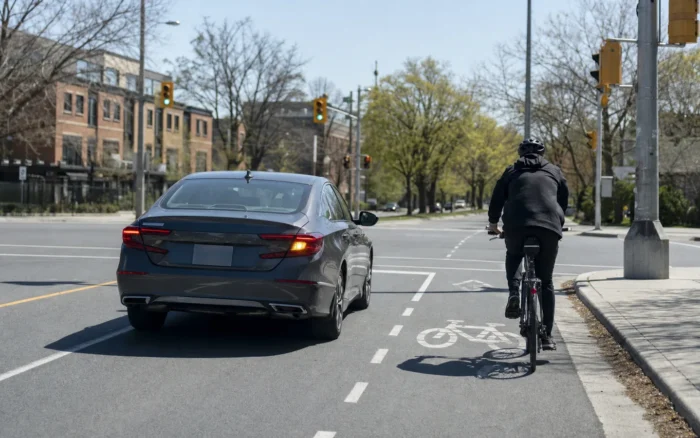
On a road with several lanes going your way, broken white lines let you move between lanes when it is safe. A solid white line asks you to hold your lane, which is why you see them approaching intersections and on ramps. The solid white line along the right edge marks where the road ends, and a thick white stop line shows exactly where to stop at a sign or signal.
Markings work with the signs
Lines rarely act alone. They back up the signs and signals around them. A no-passing zone will have both a sign and a solid yellow line, and a turn lane will have both a painted arrow and a posted sign. Reading the paint and the signs together is the skill, and it fits with how Ontario traffic sign colours and shapes work. It also helps you place your car correctly when merging onto a highway.
Why road markings are on the test
The G1 knowledge test checks that you can read the road itself, not just the signs beside it. Remember that yellow divides opposing traffic and white divides same-direction lanes, and that solid means stay while dashed means you may cross, and you have the whole system.
Keep reading: how to change lanes safely, the types of traffic signs in Ontario and right of way in Ontario explained.
Based on the Official MTO Driver’s Handbook and Ontario’s road-marking standards. Last reviewed July 2026.
A. Shabana
A. Shabana leads editorial at FreeG1, where he turns the official MTO Driver's Handbook and the realities of Ontario's G1 test into clear, practical guides. He writes for first-time and newcomer drivers who want the rules explained simply and accurately, without the filler. Every article is checked against current Ontario government sources, so readers can trust what they're studying.
More from FreeG1

Ready to pass your G1 knowledge test?
FreeG1 is free: practice questions, every Ontario traffic sign, and full mock exams.