
How to Change Lanes Safely in Ontario
A lane change is a routine, not a glance. Here is how to change lanes safely in Ontario: mirrors, signal, the shoulder check for your blind spot, then move.


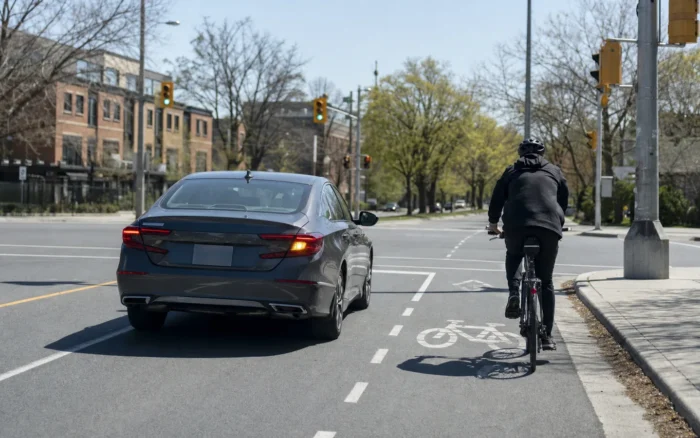
Changing lanes goes wrong when a driver treats it as a quick glance instead of a routine. The mirrors do not show everything, and the gap that looked clear a second ago may not be. Done in the right order, a lane change is one of the safest things you do on the road. Here is how to change lanes safely in Ontario.
Start with your mirrors
Before anything else, check your rear-view mirror and the side mirror on the side you are moving toward. You are building a picture of where the other cars are and how fast they are closing. Good drivers check their mirrors often anyway, so when it is time to move over they already know most of what is around them and only need to confirm it.
Signal early
Turn on your signal before you start to move, not as you drift across the line. The signal is a request, and it only works if you give other drivers time to see it and react. A few seconds of signal lets the car in the next lane ease off or make room, which is the whole point. Signalling late tells people what you are already doing instead of what you plan to do.
The shoulder check finds your blind spot
Every car has a blind spot, an area beside and slightly behind you that the mirrors do not cover. A quick glance over your shoulder toward the lane you want is the only way to see it. Keep it brief so you are not taking your eyes off the road ahead, but do not skip it, because a car sitting in that blind spot is the classic lane-change collision.
Move over when the gap is real
Once the mirrors and the shoulder check both show a clear gap, steer smoothly into the lane and cancel your signal. Change one lane at a time rather than crossing several in one sweep, and keep pace with the traffic you are joining. Never force your way into a space that is not there, and remember that a solid line is telling you to stay put for now.
Where not to change lanes
Some places are the wrong time to move over. Avoid changing lanes inside an intersection, where drivers are already watching several things. Give yourself extra room in bad weather or heavy traffic, and settle into your lane before an exit rather than swerving for it. The same care applies when you are merging onto a highway, where speed and space matter even more.
Why changing lanes is on the test
The G1 knowledge test covers lane changes because the routine is what keeps them safe. Remember the order: mirrors, signal, shoulder check, then move one lane at a time into a real gap, and you have a habit that works on every road.
Keep reading: the three-second following distance rule and Ontario traffic light rules.
Based on the Official MTO Driver’s Handbook and Ontario’s rules for lane changing. Last reviewed July 2026.
A. Shabana
A. Shabana leads editorial at FreeG1, where he turns the official MTO Driver's Handbook and the realities of Ontario's G1 test into clear, practical guides. He writes for first-time and newcomer drivers who want the rules explained simply and accurately, without the filler. Every article is checked against current Ontario government sources, so readers can trust what they're studying.
More from FreeG1
Ready to pass your G1 knowledge test?
FreeG1 is free: practice questions, every Ontario traffic sign, and full mock exams.