Passing Another Vehicle in Ontario: How to Do It Safely
Passing is one of the riskiest things you do on a two-lane road. Here is when passing is legal in Ontario and how to overtake another vehicle safely.

Passing another vehicle means pulling into the lane meant for oncoming traffic, which makes it one of the riskiest moves on a two-lane road. It is safe when you do it in the right place with enough room, and dangerous when you rush it. Here is when passing is allowed in Ontario and how to overtake without a scare.
Where passing is allowed
The centre line tells you first. A broken line on your side means you may pass when the road ahead is clear. A solid line on your side means do not pass, and a double solid line means no passing either way. Beyond the paint, you also need a clear view and enough distance to pull out, get by, and return before any oncoming traffic reaches you.
Where you must never pass
Some places are off limits no matter what the line says, because you cannot see far enough ahead. Do not pass near the crest of a hill or on a curve, where oncoming traffic can appear with no warning. Do not pass at an intersection or a railway crossing, and never pass where a no-passing sign is posted. If you are not sure you can see far enough, wait.
Pass on the left
As a rule you overtake on the left. Passing on the right is only allowed in limited situations, such as a road with two or more lanes in your direction, or when the vehicle ahead has signalled and is turning left. Undertaking on the paved right shoulder is never allowed, even when traffic ahead is slow. If you are unsure which side is correct, pass on the left, where other drivers expect you to be.
How to make the pass
Once you have a legal, clear stretch, the move is the same lane-change routine with more commitment. Signal, check your mirrors and your blind spot, and pull out smoothly. Accelerate to get past promptly, but do not exceed the speed limit to do it. Passing should be brief, not a long crawl alongside the other car.
Getting back in safely
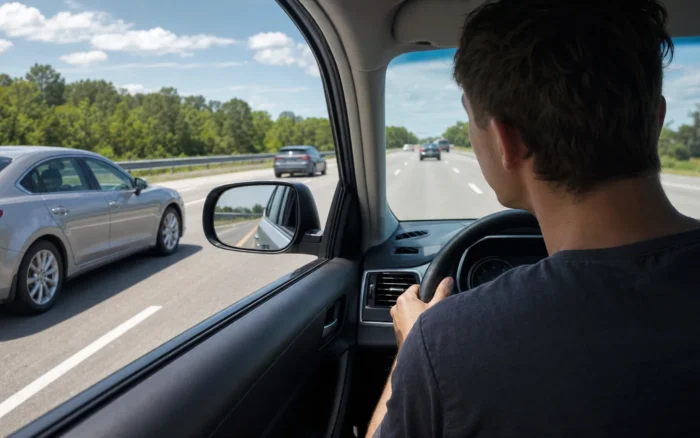
Do not cut back in the instant you clear the other vehicle. Wait until you can see it in your rear-view mirror, which means you are far enough ahead to return without crowding it. Signal, ease back into your lane, and settle to a steady speed. That mirror check is the difference between a clean pass and clipping the car you just went around.
Why passing is on the test
The G1 knowledge test covers passing because the judgment behind it keeps people alive on rural roads. Remember to pass only where the line and the view allow it, never on a hill or curve, overtake on the left, and return when you can see the vehicle in your mirror, and the manoeuvre is a safe one.
Keep reading: how to change lanes safely and Ontario speed limits explained.
Based on the Official MTO Driver’s Handbook and Ontario’s rules for passing. Last reviewed July 2026.
A. Shabana
A. Shabana leads editorial at FreeG1, where he turns the official MTO Driver's Handbook and the realities of Ontario's G1 test into clear, practical guides. He writes for first-time and newcomer drivers who want the rules explained simply and accurately, without the filler. Every article is checked against current Ontario government sources, so readers can trust what they're studying.
More from FreeG1
Ready to pass your G1 knowledge test?
FreeG1 is free: practice questions, every Ontario traffic sign, and full mock exams.