Ontario Move Over Law: Slowing Down for Stopped Emergency Vehicles
See flashing lights on a stopped vehicle ahead? Slow down, and move over a lane if you can. Here is the Ontario move over law and what it costs to ignore it.

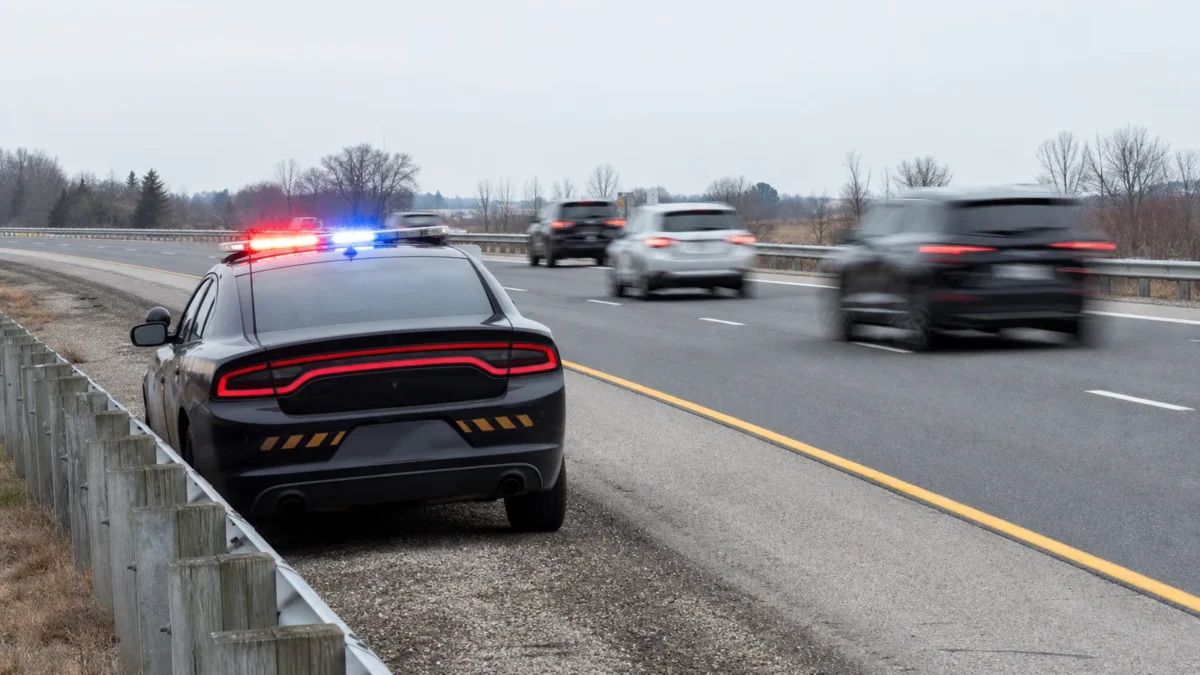
The Ontario move over law tells you exactly what to do when you come up on a stopped emergency vehicle, and it is one of the rules new drivers are most likely to get wrong. The idea is simple: give the people working at the roadside room and time. Here is what the law asks, and what it costs if you ignore it.
Slow down when you see flashing lights
When you approach a stopped emergency vehicle with its red or blue lights flashing, you must slow down and pass with caution. That covers police cars, fire trucks and ambulances stopped on the road or the shoulder. The same rule now applies to a stopped tow truck showing amber flashing lights, because tow operators work in the same exposed spot. Ease off the accelerator early rather than braking hard at the last second.
Move over a lane if you can
On a road with two or more lanes going your way, slowing down is only half of it. You also have to move over, leaving an empty lane between your car and the stopped vehicle, as long as it is safe to change lanes. Check your mirror and blind spot, signal, and move once there is a gap. If traffic makes it unsafe to change lanes, stay put and pass slowly. Protecting the people at the roadside is part of sharing the road with buses, cyclists and emergency vehicles.
Which vehicles this covers
The law is not only about police cars. It covers any stopped emergency vehicle showing red or blue flashing lights, which includes fire trucks and ambulances, and it now takes in tow trucks displaying amber lights. If you see flashing lights on a stopped vehicle ahead, treat it as a signal to slow down and get ready to move over, whatever the vehicle turns out to be. When you are not sure, slower and wider is always the safe choice.
What it costs to ignore it
The penalties are set by Ontario’s Highway Traffic Act, and they are serious. A first offence carries a fine of 400 to 2,000 dollars and three demerit points. A second offence within five years can bring a fine of 1,000 to 4,000 dollars, up to six months in jail, and a licence suspension of up to two years. Three points may not sound like much, but stacked with other tickets it moves a new driver quickly toward a suspension, which is worth understanding through how Ontario demerit points work.
Why the Ontario move over law is on the test
The G1 knowledge test checks that you can react to a roadside hazard in a predictable, safe way, and the move over law is a clear example. Remember the two steps, slow down and then move over when a lane is open, and you have the answer. Build the habit now and it becomes automatic long before you are driving on your own.
Keep reading: right of way in Ontario explained and what new drivers get wrong at night.
Based on the Official MTO Driver’s Handbook and Ontario’s rules for stopped emergency vehicles. Last reviewed July 2026.
A. Shabana
A. Shabana leads editorial at FreeG1, where he turns the official MTO Driver's Handbook and the realities of Ontario's G1 test into clear, practical guides. He writes for first-time and newcomer drivers who want the rules explained simply and accurately, without the filler. Every article is checked against current Ontario government sources, so readers can trust what they're studying.
More from FreeG1
Ready to pass your G1 knowledge test?
FreeG1 is free: practice questions, every Ontario traffic sign, and full mock exams.