Ontario Traffic Light Rules: What Each Signal Means
Red, yellow, green, and the flashing ones people get wrong. Here are the Ontario traffic light rules, including right turn on red and the advance green.


Traffic lights look simple until you meet the ones that trip people up, like a flashing green or a red light you are actually allowed to turn on. The colours are only half the system, and the other half is knowing what you may do at each one. Here are the Ontario traffic light rules, from the plain colours to the flashing signals.
Red means stop, fully
A solid red light means come to a complete stop at the stop line, and if there is no line, before the crosswalk or the edge of the intersection. Stay stopped until the light turns green. A complete stop means the wheels stop rolling, not a slow crawl through, and stopping short of the line keeps you out of the crossing where people walk.
Turning on a red light
You may turn right on a red light in Ontario after you come to a full stop, as long as the way is clear and no sign forbids it. Yield to pedestrians and to traffic already moving through the intersection before you go. A left turn on red is allowed too, but only from a one-way road onto another one-way road, again after a complete stop.
Yellow means prepare to stop
A solid yellow light means the red is coming and you should stop if you can do so safely. It does not mean speed up to beat the light. If you are already so close that stopping hard would be dangerous, continue through with care, but the default is to stop. Reading the yellow early gives you the room to stop smoothly instead of slamming the brakes.
Green means go if it is clear
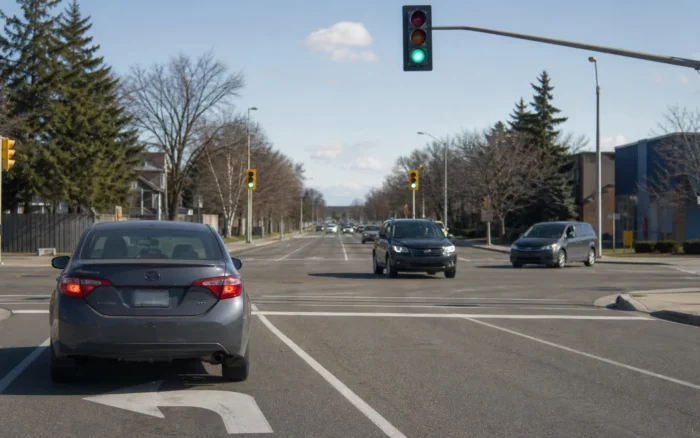
A solid green light means you may go straight through when the intersection is clear. Green is permission, not a guarantee, so you still check that the way ahead is open before entering. When you are turning left on a plain green you have to yield to oncoming traffic and to pedestrians before you complete the turn.
The flashing signals people get wrong
Flashing lights change the rule. A flashing red light means treat the intersection exactly like a stop sign: come to a full stop, then proceed when the way is clear. A flashing green light, or a green arrow, is an advance green, which means you have a protected turn because oncoming traffic is still stopped. If every light at an intersection is dark because of a power failure, treat it as an all-way stop and take turns.
Why the traffic light rules are on the test
The G1 knowledge test covers signals because the flashing and turning rules are the ones drivers guess at. Remember that red means a full stop, right on red is allowed after stopping, yellow means prepare to stop, green means go if clear, and a flashing green is a protected turn, and the whole set falls into place.
Keep reading: how four-way stops work and what the road markings mean.
Based on the Official MTO Driver’s Handbook and Ontario’s rules for traffic signals. Last reviewed July 2026.
A. Shabana
A. Shabana leads editorial at FreeG1, where he turns the official MTO Driver's Handbook and the realities of Ontario's G1 test into clear, practical guides. He writes for first-time and newcomer drivers who want the rules explained simply and accurately, without the filler. Every article is checked against current Ontario government sources, so readers can trust what they're studying.
More from FreeG1

Ready to pass your G1 knowledge test?
FreeG1 is free: practice questions, every Ontario traffic sign, and full mock exams.