Ontario U-Turn Rules: Where You Can and Cannot Turn Around
A U-turn is legal in Ontario more often than people think, and banned in five specific places. Here is where you can turn around and where you cannot.

A U turn is one of those moves new drivers avoid because they are not sure it is allowed. In Ontario it usually is, as long as you can see and be seen. The law does not ban turning around generally; it bans it in five specific situations, and every one of them comes down to whether other drivers can spot you in time.
The five places you cannot do it
Ontario prohibits a U turn in these spots. On a curve where oncoming traffic cannot see you from 150 metres away. Near the crest of a hill, for the same sight-line reason. On or near a railway crossing. Anywhere a sign prohibits it. And within 150 metres of a bridge, viaduct or tunnel where the view is blocked. Learn those five and the rest of the road is open to you.
Why 150 metres keeps coming up
The number is not random. A U turn takes several seconds and leaves your car sideways across the lane, which is the most exposed position there is. Ontario picked 150 metres because that is roughly the distance another driver needs to see you, react and stop at normal road speeds. If a curve, a hill or a bridge hides you inside that distance, the turn is banned. That is the whole logic behind the rule.
Watch for the sign
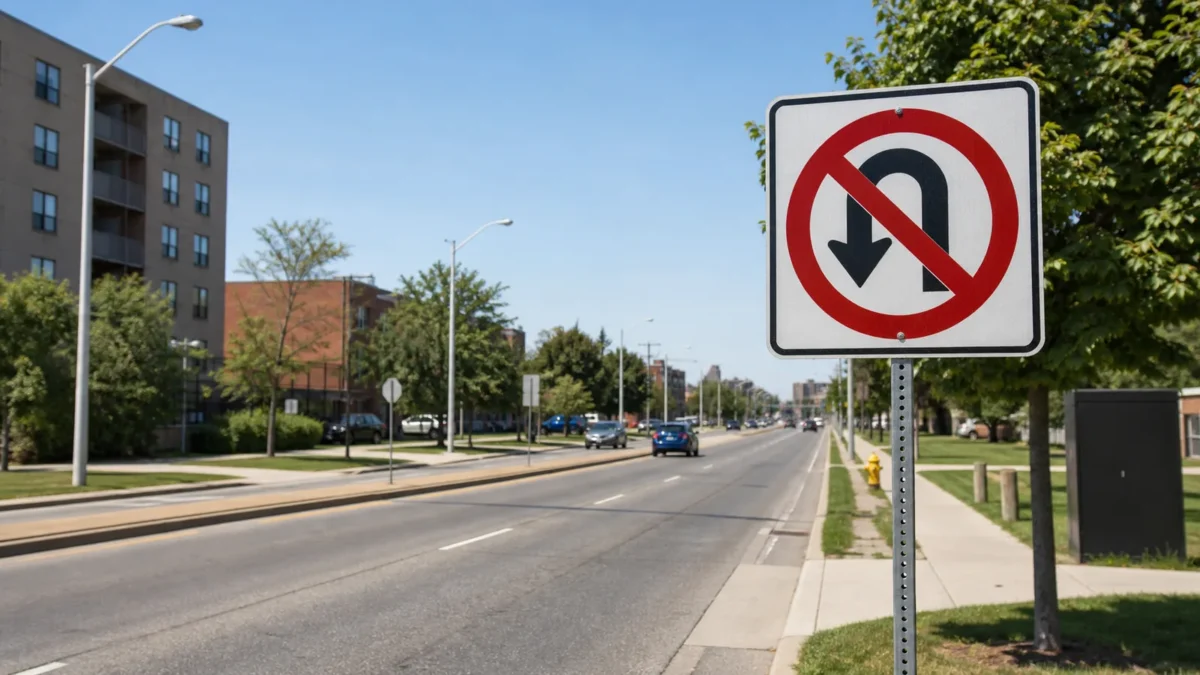
The most common ban is the simplest: a posted no U turn sign, a black arrow curving back on itself with a red circle and slash. Municipalities add these at busy intersections and near schools, so a spot that looks fine can still be off limits. Reading that sign quickly is part of how Ontario traffic sign colours and shapes work.
Never at a railway crossing
Turning around on or beside tracks is banned outright, with no sight-line test attached. A train needs far more room to stop than any car, and a vehicle turning across a crossing is exactly the situation that kills people. Treat the tracks as a no-go for turning, and follow the rest of the railway crossing rules while you are there.
How to do one properly
Where it is legal, make the turn deliberate. Signal, check your mirrors and blind spot, and wait for a real gap rather than a hopeful one. Yield to everything, because a U turn gives you no right of way at all. Complete it in one smooth movement instead of a three-point shuffle, and if the road is too narrow to swing around cleanly, drive on and find a better spot.
Why the U turn rule is on the test
The G1 knowledge test asks about U turns because the ban is about sight lines, which is a habit worth building everywhere. Remember the five banned places, curve, hill crest, railway crossing, posted sign and blocked bridge or tunnel, and the 150 metre idea behind them, and you have the answer.
Keep reading: how to make a left turn in Ontario, right of way in Ontario explained and Ontario speed limits explained.
Based on the Official MTO Driver’s Handbook and Ontario’s rules for turning. Local by-laws can add further restrictions. Last reviewed July 2026.
A. Shabana
A. Shabana leads editorial at FreeG1, where he turns the official MTO Driver's Handbook and the realities of Ontario's G1 test into clear, practical guides. He writes for first-time and newcomer drivers who want the rules explained simply and accurately, without the filler. Every article is checked against current Ontario government sources, so readers can trust what they're studying.
More from FreeG1
Ready to pass your G1 knowledge test?
FreeG1 is free: practice questions, every Ontario traffic sign, and full mock exams.