Ontario Seatbelt Law and Child Car Seat Rules for New Drivers
In Ontario everyone in the car must wear a seatbelt, and the driver answers for young passengers. Here is the seatbelt law, the fine, and the car seat stages.

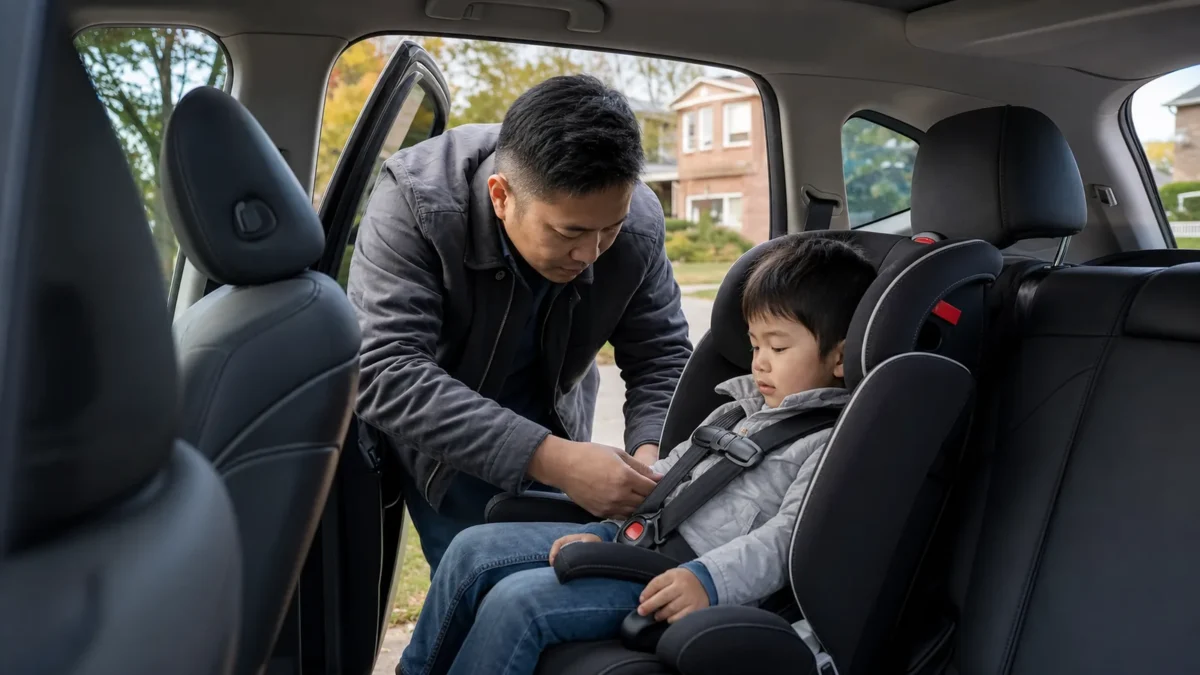
The Ontario seatbelt law is short and strict, and it puts a lot of the responsibility on the driver. Everyone in the car has to wear a seatbelt, and if you are behind the wheel you answer for the young passengers too. Here is exactly who must wear a belt, what it costs if they do not, and the car seat stages for children.
What the Ontario seatbelt law requires
Under the Ontario seatbelt law, the driver and every passenger must wear a properly fastened seatbelt, with one belt per person. You cannot share a belt or carry more people than there are working belts. If you are the driver, you are also responsible for making sure every passenger under 16 is buckled or in the correct car seat, so a quick check before you move is part of the job.
What it costs
Ontario sets the fine for a seatbelt offence at about 240 dollars, and the driver also picks up two demerit points. Those points sit on the driver even when it was a passenger who was unbuckled, which is why the responsibility rule matters. Two points may look small, but they add up, as you can see in how Ontario demerit points work.
The three car seat stages
Children move through three stages as they grow, based on weight and height rather than age alone. An infant from birth up to 9 kilograms rides in a rear-facing seat. A toddler from 9 to 18 kilograms uses a forward-facing seat with its tether strap clipped in. A child from 18 to 36 kilograms who is under 145 centimetres and under 8 years old rides in a booster seat, and can switch to a seatbelt once they pass any one of those three marks.
Wearing a seatbelt the right way
A seatbelt only protects you if it sits in the right place. The lap part should rest low across your hips and the tops of your thighs, not across your stomach, where it can cause injury in a hard stop. The shoulder part should cross the middle of your chest and shoulder, never under your arm or tucked behind your back. Keep the whole belt flat and snug with no slack or twists. Tucking the shoulder strap out of the way feels more comfortable, but it removes most of the protection in a crash and still counts as wearing the belt improperly.
Why the seatbelt rule is on the test
The G1 knowledge test checks the seatbelt law because it is one of the simplest ways to survive a crash, and because new drivers often carry younger family members. Remember that everyone buckles, the driver is responsible for anyone under 16, and children follow the weight-based car seat stages, and you will not trip over one of the common mistakes that fail the G1 test.
Keep reading: alcohol, drugs and zero tolerance for new drivers and Ontario distracted driving and phone laws.
Based on the Official MTO Driver’s Handbook and Ontario’s rules for seatbelts and car seats. Last reviewed July 2026.
A. Shabana
A. Shabana leads editorial at FreeG1, where he turns the official MTO Driver's Handbook and the realities of Ontario's G1 test into clear, practical guides. He writes for first-time and newcomer drivers who want the rules explained simply and accurately, without the filler. Every article is checked against current Ontario government sources, so readers can trust what they're studying.
More from FreeG1
Ready to pass your G1 knowledge test?
FreeG1 is free: practice questions, every Ontario traffic sign, and full mock exams.